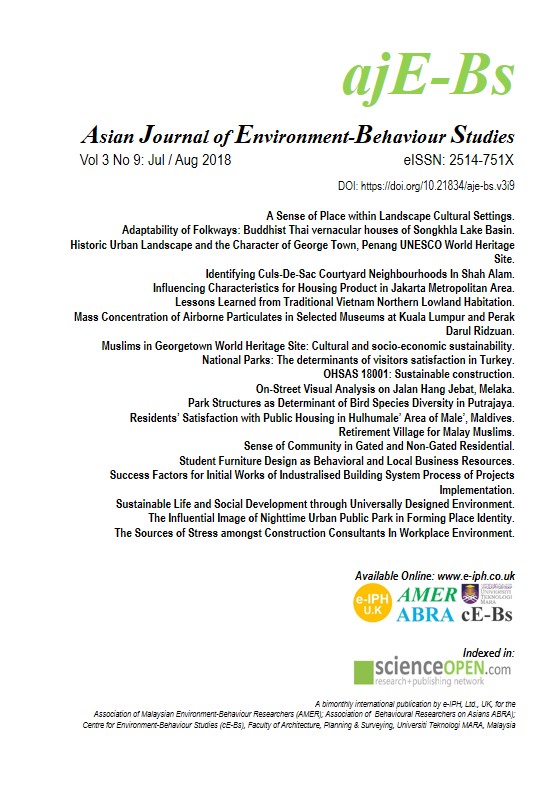
Influencing Characteristics for Housing Product in Jakarta Metropolitan Area
DOI:
https://doi.org/10.21834/aje-bs.v3i9.298Keywords:
Real Estate, Property, Consumer Preferences, Property Practitioner PerceptionAbstract
This research paper will try to analyze the relationship between influencing characteristics for housing product prices in Jakarta Metropolitan Region. The aforementioned characteristics are viewed from the property practitioner's perception. To find the answer to this research paper's questions, seven property practitioners were interviewed to test the initial hypotheses. The findings suggest that brands, facilities, developer reputations, pricing policies, reinvestment values, and speculative behavior play significant parts as internal and external attributes for housing prices in Jakarta Metropolitan Region.
References
Aluko, B. T. (2007). Examining valuer’s judgement in residential property valuations in residential property valuations in metropolitan Lagos, Nigeria. Journal of Property Management, 98-107. DOI: https://doi.org/10.1108/02637470710723281
Babawale, G. K., & Oyalowo, B. A. (2011). Incorporating Sustainability into Real Estate Valuation: the Perception of Nigerian Valuers. Journal of Sustainable Development, 236-248. DOI: https://doi.org/10.5539/jsd.v4n4p236
Baker, D. (2008). The housing bubble and the financial crisis. Washington DC: Center for Economic and Policy Research.
Blakely, E. J., & Snyder, M. G. (1998). Fortress America: gated communities in the United States. Washington, D.C.: Brookings Institution Press.
Chang, N. S., & Havard, T. M. (2009). Understand How Developers Construct the Pricing of the Residential Property by Process Tracing Protocol. 16th Annual European Real Estate Society Conference in Stockholm, Sweden.
Daly, J., Gronow, S., Jenkins, D., & Plimmer, F. (2003). Customer behavior in the valuation of residential property: A comparative study in the UK, Ireland and Australia. Journal of Property Management, 295-314. DOI: https://doi.org/10.1108/02637470310508653
Eves, C. (2007). Planned residential community developments: do they add value? Journal of Property Management, 164-179. DOI: https://doi.org/10.1108/02637470710741524
Hapsariniaty, A. W., Sidi, B. D., & Nurdini, A. (2013). Comparative Analysis of Choosing to Live in Gated Communities: A case study of Bandung metropolitan area. AiC-QoL 2013 Langkawi Procedia Social and Behavioral Science, 394-403. DOI: https://doi.org/10.1016/j.sbspro.2013.07.213
Hwang, M., Quigley, J.M. (2006). Economic Fundamentals in Local Housing Markets: Evidence from U.S. Metropolitan Region. Journal of Regional Science, 46(3), 425-453 DOI: https://doi.org/10.1111/j.1467-9787.2006.00480.x
Hoshino, T. (2008). Estimation and Analysis of Preference Heterogeneity in Residential Choice Behavior. Department of Geography and Environment, London School of Economics, 1-29.
Knight, T. (2011). The perceptions of property developers : approaches to the process of development. Centre for Environment and Society Research, 1-17.
Kopitz, E., McConnell, V., & Walls, M. (2007). The Trade-off between Private Lots and Public Open Space in Subdivisions at the Urban–Rural Fringe. Resources for the Future, 1-19. DOI: https://doi.org/10.2139/ssrn.1001941
Mankiw. N. G., Weil, D. N. (1989). The Baby Boom, the Baby Bust, and the Housing Market. Regional Science and Urban Economics, 19, 235-258 DOI: https://doi.org/10.1016/0166-0462(89)90005-7
Malpezzi, S. (1996). Housing Prices, Externalities, and Regulation in U.S. Metropolitan Areas. Journal of Housing Research, 7 (2), 209-241
Malpezzi, S., Wachter, S. M. (2004), The Role of Speculation in Real Estate Cycles. Zell/Lurie Center Working Papers 401, Wharton School Samuel Zell and Robert Lurie Real Estate Center, University of Pennsylvania.
Pornchokchai, P. (2011). Real Estate Cycles: What Can We Learn? 17th AVA Pre-congress, Thailand 9 July 20-22, 2011, Siem Reap, Cambodia.
Rahadi, R. A., Wiryono, S. K., Koesrindartoto, D. P., Syamwil, I. B. (2012). Relationship between Consumer
Preferences and Value Propositions: A Study of Residential Product. AcE-Bs 2012 Bangkok Procedia - Social and Behavioral Sciences, 50, 865-874. DOI: https://doi.org/10.1016/j.sbspro.2012.08.088
Reed, R., Wu, H., (2010), Understanding property cycles in a residential market, Property Management, 28 (1), 33-46. DOI: https://doi.org/10.1108/02637471011017163
Shafiei, M. W., Foo, F. S., Said, I., & Omran, A. (2010). Malacca House Buyers' Housing Preferences in Malaysian New Residential Market. ANNALS of Faculty Engineering Hunedoara - International Journal of Engineering, 217-226.
Simanungkalit, P. (2009). Property Investment Strategy in the Global Crisis. Tjiptono Darmadji Network “Seminar Investment In Property”, April 14, 2009, Le Meridien Hotel, Jakarta.
Weimer, A. M. (1966). Real Estate Decisions are Different. Harvard Business Review, 105-112.
Yusof, A. (2001). Economy and Commercial Construction Cycle in Malaysia, PRRES Conference 2001, January 21-24, 2001. Adelaide, the Pacific Rim Real Estate Society (PRRES).
Zinas, B. Z., Jusan, M. M. (2010). Choice Behaviour of Housing Attributes: Theory and Measurement, Asian Journal of Environment-Behaviour Studies, 1(2), 1-18.
Downloads
Published
How to Cite
Issue
Section
License
Copyright (c) 2018 Raden Aswin Rahadi, Sudarso Kaderi Wiryono, Deddy Priatmodjo Koesrindartoto, Indra Budiman Syamwil

This work is licensed under a Creative Commons Attribution-NonCommercial-NoDerivatives 4.0 International License.