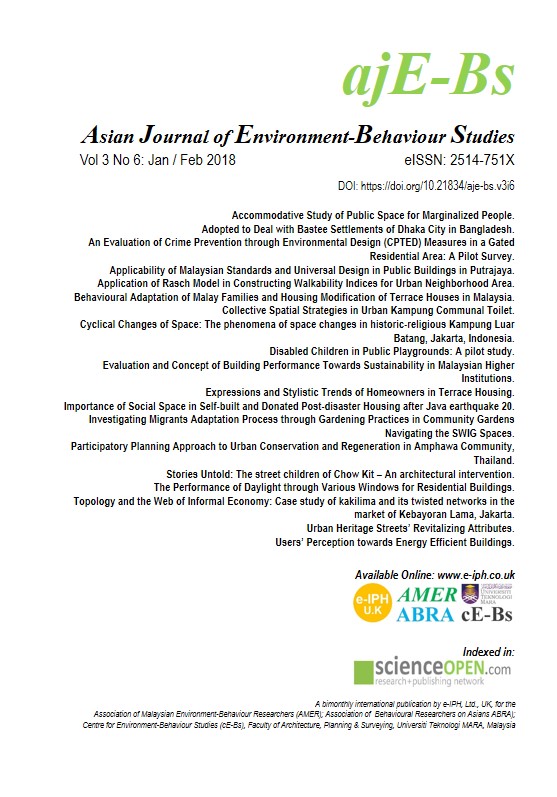
Collective Spatial Strategies in Urban Kampung Communal Toilet
DOI:
https://doi.org/10.21834/aje-bs.v3i6.236Keywords:
Urban Kampung, Community, Spatial, Strategies, ToiletAbstract
Living in a high-density urban kampung with limited space and resources involves challenges to meet basic service needs. Various collective spatial systems represent the community strategies in dealing with their limited situation. This paper addresses the communal toilet system in urban kampung as a collective spatial system developed by the community. The study identifies various spatial strategies incorporated within the system, as well as social structures embedded within the spatial practice. The understanding of the spatial and social systems in the communal toilet system provides some insights for the development of appropriate spatial strategies for urban kampung communities.
References
Ahmed, N. and Sohail, M. (2003). Alternative water supply arrangements in peri-urban localities: awami (people’s) tanks in Orangi township, Karachi. Environment and Urbanization, 15(2), 33-42. DOI: https://doi.org/10.1177/095624780301500218
Borden, I. et al. (Eds.) (2001). The unknown city: Contesting architecture and social space. Cambridge, MA: The MIT Press. DOI: https://doi.org/10.7551/mitpress/7008.001.0001
Burra, S., Patel, S. and Kerr, T. (2003). Community-designed, built and managed toilet blocks in Indian cities. Environment and Urbanization, 15(2), 11-32. Highmore, B. (Ed.) (2002). The everyday life reader. London: Routledge. DOI: https://doi.org/10.1177/095624780301500202
Inerfeld, R. B. and Blom, B. B. (2002). A new tool for strengthening urban neighborhoods. Journal of Affordable Housing, 11(2), 128-134
Lefebvre, H. (1991). The production of space. Cambridge: Blackwell.
Martin, D. G. (2003). Enacting neighborhood. Urban Geography, 24(5), 361-85. DOI: https://doi.org/10.2747/0272-3638.24.5.361
Oldfield, S. (2000). The centrality of community Capacity in state low-income housing provision in Cape Town, South Africa. International Journal of Urban and Regional Research, 24(4), 858-72. DOI: https://doi.org/10.1111/1468-2427.00283
Pile, S. (2001). The un(known) city... or, an urban geography of what lies buried below the surface. In I. Borden et al (Eds.), The unknown city: Contesting architecture and social space (pp. 262-78). Cambridge, MA: The MIT Press.
Schnell, I. and Goldhaber, R. (2001). The social structure of Tel-Aviv–Jaffa neighborhoods. Environment and Behavior, 33, 765-95. DOI: https://doi.org/10.1177/00139160121973232
Wegelin-Schuringa, M. and Kodo, T. (1997). Tenancy and sanitation provision in informal settlements in Nairobi: revisiting the public latrine option. Environment and Urbanization, 9(2), 181-190. DOI: https://doi.org/10.1177/095624789700900208
WHO and UNICEF (2010). Progress on sanitation and drinking water: Update 2010. Switzerland: WHO Press.
Wigglesworth, S. and Till, J. (Eds.) (1998). The everyday and architecture. Architectural Design, Academy Press.
Downloads
Published
How to Cite
Issue
Section
License
Copyright (c) 2018 Yandi Andri Yatmo, Paramita Atmodiwirjo

This work is licensed under a Creative Commons Attribution-NonCommercial-NoDerivatives 4.0 International License.