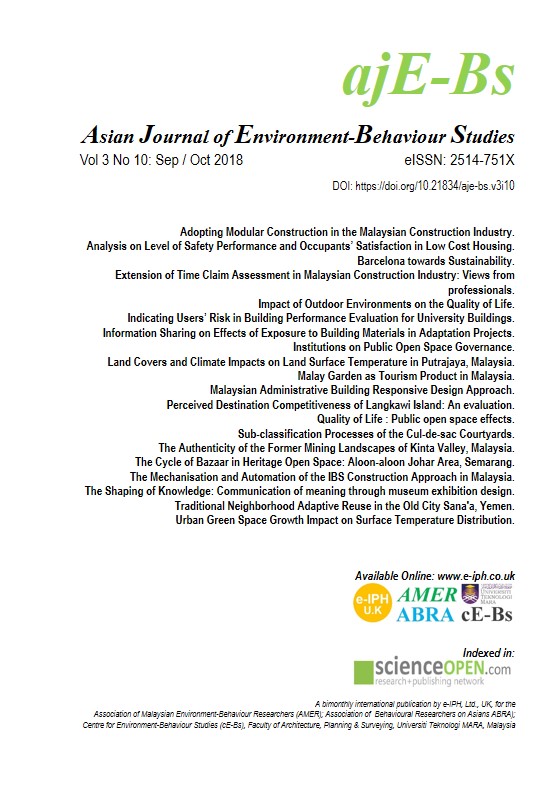
Malaysian Administrative Building Responsive Design Approach
DOI:
https://doi.org/10.21834/aje-bs.v3i10.317Keywords:
Administration Architecture, Form and Space Study, Parliament, Perdana PutraAbstract
The main purpose of this paper is to elucidate on the study of state administrative building in Malaysia by describing the design built form and it adaptation towards the surrounding. Using multiple case study approach, Perdana Putra and Parliament Malaysia were chosen as prominent case studies with emphasis on form and space studies. Since this paper formulates new ways to describe on state administrative building design, it uses interpretive paradigm and semiotics as the methodological approach to study the relationship between building design and sustainable aspects. This paper is of value for practicing architects and society as it offers new insights by formulating design approaches in designing public architecture in Malaysia.
References
Bari, N. A. A., Abdullah, N. A., Yusuff, R., Ismail, N., & Jaapar, A. (2012). Environmental Awareness and Benefits of Industrialized Building Systems (IBS). Procedia-Social and Behavioral Sciences, 50, 392-404. DOI: https://doi.org/10.1016/j.sbspro.2012.08.044
Barthes, R. (1988). The semiotic challenge. Oxford: Basil Blackwell.Chandler, D. (2007). Semiotics: the basics. Routledge.
Ching, F. D. (2010). Architecture: Form, space, and order. Wiley. com.
Cheshmehzangi, A. (2012). Identity and public realm. Procedia-Social and Behavioral Sciences, 50, 307-317. DOI: https://doi.org/10.1016/j.sbspro.2012.08.036
Hillier, B. (2007). Space is the machine: a configurational theory of architecture.
Husin, S. N. F. S., & Harith, Z. Y. H. (2012). The Performance of Daylight through Various Type of Fenestration in Residential Building. Procedia-Social and Behavioral Sciences, 36, 196-203. DOI: https://doi.org/10.1016/j.sbspro.2012.03.022
Kien, L. C. (2007) Building Merdeka: Independence Architecture in Kuala Lumpur, 1957– 1966. Kuala Lumpur: Galeri Petronas.
Mahdavinejad, M., & Mansoori, S. (2012). Architectural design criteria of socio-behavioral approach toward healthy model. Procedia-Social and Behavioral Sciences, 35, 475-482. DOI: https://doi.org/10.1016/j.sbspro.2012.02.113
Mohidin, H. H. B., & Ismail, A. S. (2014, February). Historical development of administration architecture in Malaysia (15th-21st century). In IOP Conference Series: Earth and Environmental Science (Vol. 18, No. 1, p. 012089). IOP Publishing. DOI: https://doi.org/10.1088/1755-1315/18/1/012089
Puspitasari, P., Djunaedi, S. A., & Putra, H. S. A. (2012). Ritual and Space Structure: Pilgrimage and Space Use in Historical Urban Kampung Context of Luar Batang (Jakarta, Indonesia). Procedia-Social and Behavioral Sciences, 36, 350-360. DOI: https://doi.org/10.1016/j.sbspro.2012.03.039
Putrajaya Holdings Sdn. Bhd, & Pusat Pentadbiran Kerajaan Persekutuan (Malaysia). (2001). Appreciation of the Architecture & Interior Design of the Office of the Prime Minister of Malaysia. Putrajaya Holdings.
Riza, M., Doratli, N., & Fasli, M. (2012). City Branding and Identity. Procedia-Social and Behavioral Sciences, 35, 293-300. DOI: https://doi.org/10.1016/j.sbspro.2012.02.091
Rogers, W. (2004). Frank Lloyd Wright’s “Organic Architecture”: An Ecological Approach in Theory and Practice. DOI: https://doi.org/10.1007/1-4020-2245-X_20
Imaginatio Creatrix, 381-390. Shahoran Bin Johan Ariffini (2003): Putrajaya, Malaysia, Australian Planner, 40:3,40-42. DOI: https://doi.org/10.1080/07293682.2003.9995277
Shatha, M. (2004). Local identity of modern Amman–Jordan: a perceptual approach towards identifying an intersubjective and shared architectural schemata. Urban design international, 9(3), 119-131. DOI: https://doi.org/10.1057/palgrave.udi.9000119
Vale, J. Lawrence (2008) Architecture, Power, and National Identity. London and New York: Routledge.
Zainordin, N. B., Abdullah, S. M. B., & Baharum, Z. B. A. (2012). Light and Space: Users Perception towards Energy Efficient Buildings. Procedia-Social and Behavioral Sciences, 36, 51-60. DOI: https://doi.org/10.1016/j.sbspro.2012.03.006
Downloads
Published
How to Cite
Issue
Section
License
Copyright (c) 2018 Asian Journal of Environment-Behaviour Studies

This work is licensed under a Creative Commons Attribution-NonCommercial-NoDerivatives 4.0 International License.