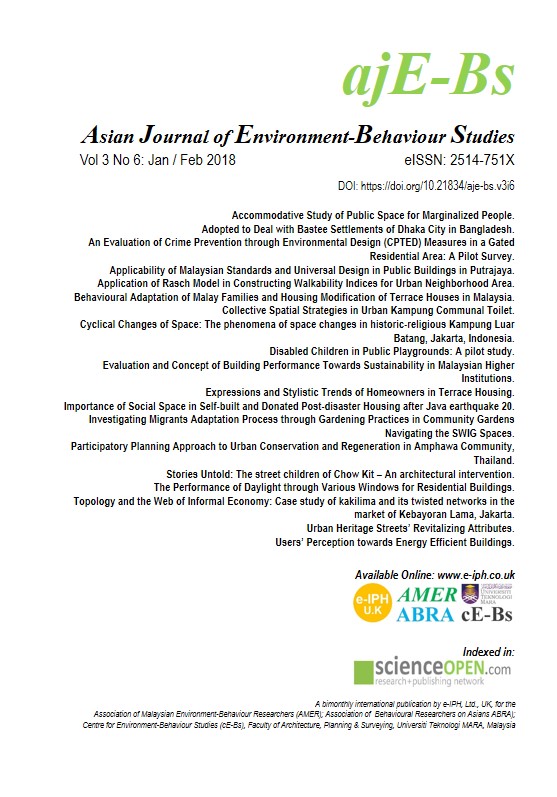
Disabled Children in Public Playgrounds: A pilot study
DOI:
https://doi.org/10.21834/aje-bs.v3i6.238Keywords:
Disabled Children, Public Playgrounds, Post-Occupancy Study, Quality of LifeAbstract
This is a cross-sectional pilot study on children with disabilities' needs in public playgrounds. They often faced problems at public playgrounds, entertainment and amusement areas, due to the lack of ample provisions to cater for their special needs. The purpose of the study was to investigate the current status of infrastructure and design proper public playgrounds in Malaysia. The study period was six months. Overall 40 disabled children, parents, teachers and doctors were questioned and interviewed. Statistical Package for the Social Science (SPSS) software program was used for analysis. The finding revealed that there is a necessary need to improve and construct well-equipped public playgrounds for children with disabilities.
References
Anonymous3. (2003). Available at http://www.mpm.org.tr/Docs/03_OZURLULER%20TURIZMI.pdf (accessed 25 August 2010).
Bogdan, R. C., & Sari Knopp, B. (2007). Qualitative research for education: An introduction to theories and methods (5th ed.).
Dattner, R. (1969). Design for Play. The MIT Press, Cambridge, Massachusetts and London, England.
Do¨kmeci, V., & Berko¨z, L. (1994). Transformation of Istanbul’s CBD from a monocentric to a polycentric city. European Planning Studies, 2(2), 193 – 205. DOI: https://doi.org/10.1080/09654319408720259
Dunn, K., Moore, M., & Murray, P. (2003). Best Practice in Inclusive Out of School Provision. London, Kidsactive.
Fiske, D., W, Campbell, & Donald, T. (1959). Convergent and discriminant validation by the multitrait mutimethod matrix.” Psychological Bulletin. 56, 81 – 105. DOI: https://doi.org/10.1037/h0046016
Gant, R. (1997). Pedestrianisation and disabled people: A study of personal mobility in Kingston town centre. Disability and Society. 12(5), 723 – 740. DOI: https://doi.org/10.1080/09687599727010
Gould, S. J. (1996). Full House: The spread of excellence from Plato to Darwin. Harmony Books. . New York. DOI: https://doi.org/10.4159/harvard.9780674063396
Huttenlocher, P. R. (1990). Morphometric Study of Human Cerebral Cortex Development. Neuropsychological, 28(6). DOI: https://doi.org/10.1016/0028-3932(90)90031-I
Huttenlocher, P. R. (1992). Neural Plasticity, in Asbury, McKhann and McDonald (eds). Diseases of the Nervous System. 1, 63 – 71.
Lewin, K. (1946). Action Research and Minority Problems. Journal of Social Issues, 2, 34 – 46. DOI: https://doi.org/10.1111/j.1540-4560.1946.tb02295.x
NPFA, C. s. P. C. p. l. B. P. (2000). what play provision should do for children. London: .
ODPM, O. o. t. D. P. M. (2002). Living Places: Cleaner, Safer, Greener. London, ODPM.
ODPM, O. o. t. D. P. M. (2003). Sustainable Communities: Building for the Future. London, ODPM
Oliver, M. (1996). 1nderstanding Disability? From theory to practice. Retrieved from http://www.brainhe.com/TheSocialModelofDisabilityText.html
Downloads
Published
How to Cite
Issue
Section
License
Copyright (c) 2018 Seyed Hassan Khalifeh Soltani, Mohamed Yusoff Abbas, Mohamad Awang

This work is licensed under a Creative Commons Attribution-NonCommercial-NoDerivatives 4.0 International License.