
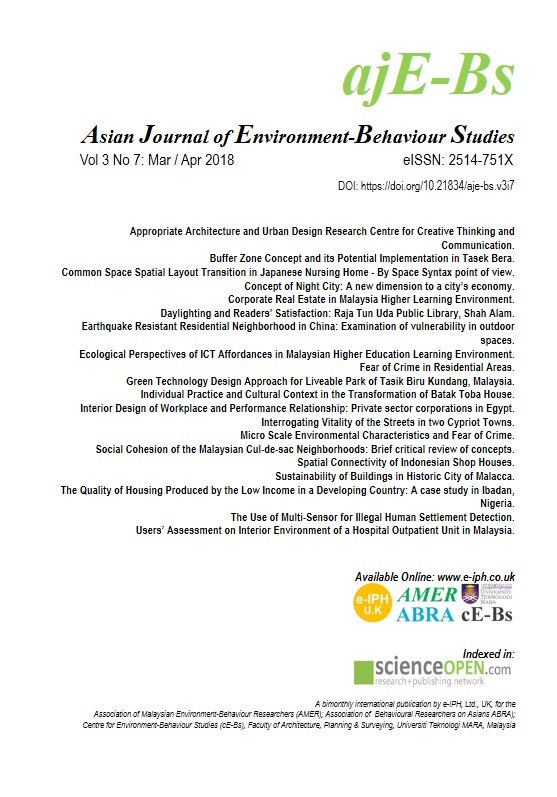
Ecological Perspectives of ICT Affordances in Malaysian Higher Education Learning Environment
DOI:
https://doi.org/10.21834/aje-bs.v3i7.260Keywords:
Affordances, e-Learning, e-Learning Environment, ICT FacilitiesAbstract
There is a continuous struggle on understanding learning settings, particularly with ICT integrations (i.e. incorporate the use of ICT in teaching and learning practice and environment). This paper aims to illuminate an alternative means of understanding the virtual learning environment which is through affordances (perception-action coupling). A qualitative inquiry was implemented in gathering participants' experiences and perceptions regarding ICT integration in teaching practices through focus group discussions and semi-structured interviews. This study shows that preferences for ICT integration in a learning environment are closely related to ICT affordances. Understanding ICT affordances is indispensable in order to assess the conduciveness of learning environments with ICT integrations.
References
Ministry of Education, Malaysia, (2003). Educational Development Plan for Malaysia 2001-2010. Kuala Lumpur: Ministry of Education. Available online at: http://planipolis.iiep.unesco.org/upload/Malaysia/Malaysia%20Education%20development%20plan%202001-2010%20summary.pdf.
Gaver, W.W. (1991). Technology affordances. Proceedings of the Conference on the CHI 91Human Factors in Computing Systmes Conference, ACM, p.79-84. DOI: https://doi.org/10.1145/108844.108856
Gibson, J. J. (1977). The Theory of Affordances. In R. E. Shaw & J. Bransford (Eds.), Perceiving, Acting, and Knowing. Hillsdale, NJ: Lawrence Erlbaum Associates.
Gibson, J. J. (1979). The Ecological Approach to Visual Perception. Boston: Houghton Mifflin.
Kennedy, D. & McNaught, C. (1997). Design Elements for Interactive Multimedia. Australian Journal of Educational Technology, 13 (1), 1-22 DOI: https://doi.org/10.14742/ajet.1916
Mathers, N., Fox, N., Hunn, A. (1998). Trent Focus for Research and Development in Primary Heath Care: Using Interview in a Research Project. Sheffield: Trent Focus Group.
Miyake, N. (2007). Computer Supported Collaborative Learning. In R. Andrew and C. Haythornthwaite (Eds.), The SAGE Handbook of E-Learning Research. London: SAGE Publications Ltd. DOI: https://doi.org/10.4135/9781848607859.n11
Mokhtar, S., Alias R., Rahman A., (2007). Rubric for Assessing ICT Infrastructure in Malaysia Higher Education. Available online at: http://eprinzzts.utm.my/3292/3/Shamsul_Anuar_Mokhtar_(After_Review)_ PARS_’06-edited.pdf, last viewed August 2011.
National Philosophy of Education, Retrieved date: 1st August 2011. From, http://jpt.mohe.gov.my/index.php
Norman, D. A. (1988). The Psychology of Everyday Things. New York: Basic Books.
Norman, D. A. (1990). The Design of Everyday Things. New York: Doubleday.
Strijbos, J. W., Kirschner, P. A., & Martens, R. L. (2004). (Eds.) What We Know about CSCL: And Implementing it in Higher Education. Boston, MA: Kluwer Academic/Springer Verlag. DOI: https://doi.org/10.1007/1-4020-7921-4
Tenth Malaysia Plan 2011-2015 (n.d.) Retrieved date: 1st August 2011. From: http://www.nitc.my/
UNESCO (2001), Meta-survey on the Use of Technologies in Education in Asia and the Pacißc. Paris: UNESCO.
Downloads
Published
How to Cite
Issue
Section
License
Copyright (c) 2018 Magdalina Jamian, Habibah Ab Jalil, Steven Eric Krauss

This work is licensed under a Creative Commons Attribution-NonCommercial-NoDerivatives 4.0 International License.


