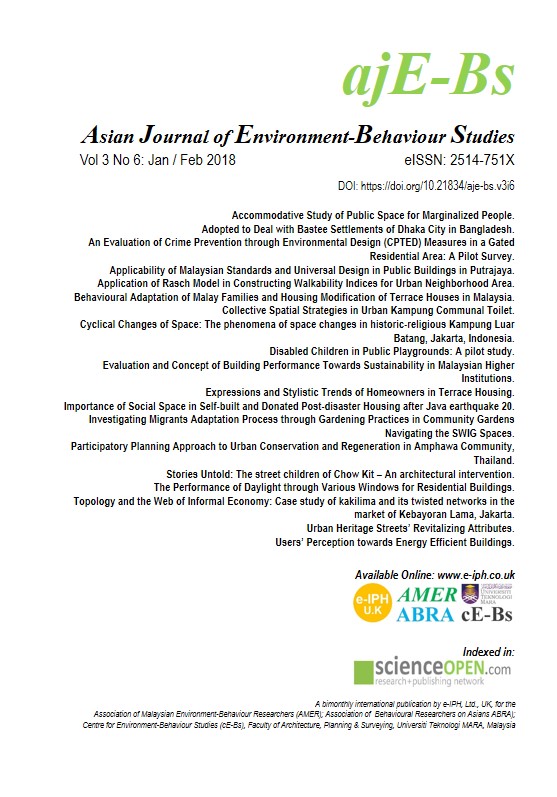
Behavioural Adaptation of Malay Families and Housing Modification of Terrace Houses in Malaysia
DOI:
https://doi.org/10.21834/aje-bs.v3i6.235Keywords:
Behavioural Adaptation, Housing Modification, Privacy, Social InteractionAbstract
This paper examines the behavioural adaptation of Malay families living in terrace houses with regard to the activity system, privacy and social interaction among Malay families and terrace housing modification. The study uses case studies of 11 Malay families living in three-bedroom two-storey terrace houses in two urban locations in Malaysia. Findings indicate that behavioural adaptation resulted in changes in some aspects of the Malay culture and housing modifications provided a more supportive living environment but have adverse effects on individual families and the housing communities due to the constraints of the terrace housing design.
References
Altman, I. (1975). The Environment and Social Behavior: Privacy, Personal Space, Territoriality and Crowding. California: Brooks/Cole.
Ahmad Hariza, H., and Zaiton, A. R., Sharifah Norazizan, S. A. R. & Nurizan, Y. (2006). Visual Privacy and Family Intimacy: A Case Study of Malay Inhabitant Living in Two-Storey Low Cost Housing. Journal of Environment and Planning B, 33, 301 – 318. DOI: https://doi.org/10.1068/b31053
Archea, J. (1977). The Place of Architectural Factors in Behavioural Theories of Privacy. Journal of Social Issues, 33(3), 116 – 137. DOI: https://doi.org/10.1111/j.1540-4560.1977.tb01886.x
Baron, R. A., and Byrne, D. (1991). Social Psychology – Understanding Human Interaction (2nd ed). London: Allyn and Bacon.
Bechtel, R. B., Marans, R. W., and Michelson, W. (Eds) (1990). Methods in Environmental and Behavioral Research. Florida: Robert E. Krieger Publishing Company.
Booth, A., Edward, J. N., and Edwards, P. K. (1982). Housing Type, Stress and Family Relations. (Social Forces. 61(1), 244 – 257. DOI: https://doi.org/10.2307/2578084
Fatimah, A. (1994). Urbanisasi dan Kekeluargaan: Satu Kajian Kes Kelas Menengah Melayu di Kuala Lumpur, Unpublished Ph.D Thesis, University Malaya, Kuala Lumpur.
Flick, U. (1998). An Introduction to Qualitative Research. Thousand Oaks, California: Sage.
Guiliani, M. V., Rullo, G., and Bove, G. (1990). Socializing and Privacy Spaces Inside Homes. An Empirical Study. Proceedings 11th International Conference of International Association of People Built Environment Study IAPS (pp. 129 – 138). Ankara, IAPS.
Hanson, S., and Hanson, P. (1993). The Geography of Everyday Life. In T. Garling & R. G. Golledge (Eds). Behavior and Environment: Psychological and Geographical Approaches. (pp. 249 – 269). DOI: https://doi.org/10.1016/S0166-4115(08)60046-1
Lim. J. Y. (1987). 7he Malay House. Rediscovering Malaysia’s Indigenous Shelter System. Pulau Pinang: Institut Masyarakat.
Lonner, W. J. & Berry, L. W. (1986). Field Methods in Cross-cultural Research. Beverly Hills, California: Sage.
Mohamad Tajuddin, M. R. (2003, July 19). Terrace Living. Properties Times. New (traits 7imes. http://property.nst.com.my/?eekly/ PropertyTimes/viewpoint
Nasar, J. L. (1989). Symbolic Meanings of House Style. Environment and Behaviour, 21(3), 235 – 257. DOI: https://doi.org/10.1177/0013916589213001
Proshansky, H. M., Ittelson, W. H., and Rivlin, L. G. (1970). The Influence of the Physical Environment on Behaviour: Some Basic Assumptions. In H. M. Proshansky, W. H. Ittelson, & L. G. Rivlin. (Eds) Environmental Psychology: Man and his Physical Setting. (pp. 27 – 37). New York: Holt, Rinehart and Winston, Inc.
Rapoport, A (2005). Culture, Architecture and Design. Chicago: Locke Science Pub. Co.
Rapoport, A., & Hardie, G. J. (1991). Cultural change analysis: Core concepts of housing for Tswana. In Tipple, A. G. & Willis, K. G. (eds) (1991), Housing for the Poor in the Developing World. Pp 35-61. New York: Routledge.
Rapoport, A. (1981). Identity and Environment. A cross-cultural environment. In J. S. Duncan (Ed).Housing and Identity. (pp. 6 – 35). New York: Holmes & Meier.
Rivlin, R. G. (2000). Reflections on the Assumptions and Foundations of Work in Environmental Psychology. In S. Wapner, J. Demick, T. Yamamoto, & H. Minami (Eds). Theoretical Perspectives in Environment-Behavior Research: Underlying Assumptions, Research Problems, and Methodology. (pp. 51 – 60). New York: Kluwer Academic/ Plenum Publishers.
Vlatseas, S. (1990). A History of Malaysian Architecture. Singapore: Longman Singapore Publishers Pte. Ltd.
Wapner, S., Demick, J., Yamamoto, T., and Minami, H. (Eds). (2000). Theoretical Perspectives in Environment-Behavior Research: Underlying Assumptions, Research Problems, and Methodology. New York: Kluwer Academic/Plenum Publishers. DOI: https://doi.org/10.1007/978-1-4615-4701-3
Yaakob, H. (1992). Keluarga Melayu Bandar, Satu Analysis Perubahan. Kuala Lumpur: Dewan Bahasa dan Pustaka.
Downloads
Published
How to Cite
Issue
Section
License
Copyright (c) 2018 Zaiton Abdul Rahim, Ahmad Hariza Hashim

This work is licensed under a Creative Commons Attribution-NonCommercial-NoDerivatives 4.0 International License.