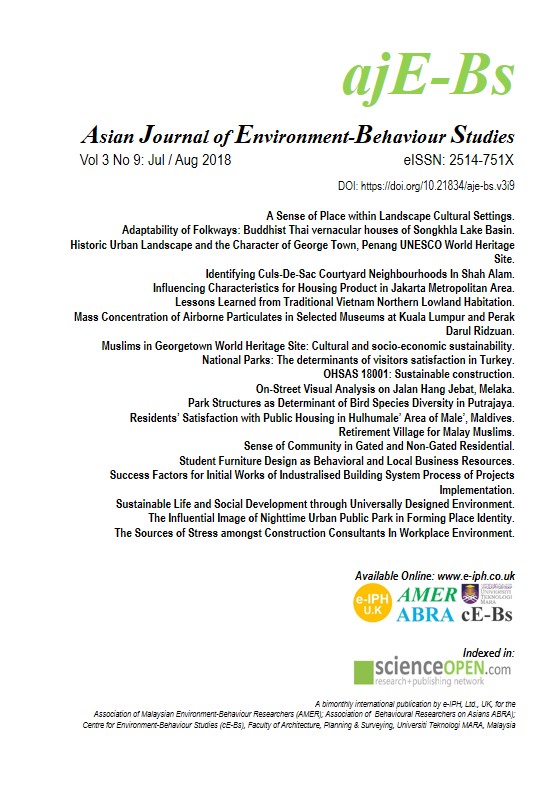
Sustainable Life and Social Development through Universally Designed Environment
DOI:
https://doi.org/10.21834/aje-bs.v5i17.49Keywords:
Universal Design, Social Sustainability, Sustainable Life, Social DevelopmentAbstract
A universally designed environment provides comfort, adaptability and flexibility that can help to reduce human life cycle impact and encourage residents' participation in the community. With that, the purpose of this conceptual study is to explore the concept of Universal Design (UD) as a significant aspect of social sustainability, based on professional practitioners' and scholarly views. UD implementation in a built environment may cater for the needs of diverse users over the changing abilities throughout their lifespan. This study concludes that UD has evolved as a significant component for sustainable life and social development within the individual's own dwelling and the community as well.
References
Alkire, S. (2005). Why the Capability Approach? Journal of Human Development, 6(1), 115–133. DOI: https://doi.org/10.1080/146498805200034275
Askalen, F., Bergh, S., Bringa, O.R. and Heggem, E.K. (1997). Universal Design: Planning and design for all. GLADNET Collection, 12 January 1997. The Norwegian State Council on Disability.
Bramley, G., Dempsey, N., Power, S., Brown, C. and Watkins, D. (2009). Social Sustainability and Urban Form: Evidence from five British cities. Environment and Planning A, 41, 2125-2142. DOI: https://doi.org/10.1068/a4184
Choguill, C.L. (2008). Developing sustainable neighbourhoods. Habitat International, 32, 41-48. DOI: https://doi.org/10.1016/j.habitatint.2007.06.007
Colantonio, A. (n.d.). Social Sustainability: Linking Research to Policy and Practice. Retrieved 27 January 2013 from http://ec.europa.eu/research/sd/conference/2009/papers/7/andrea_colantonio_-_social_sustainability.pdf
Dave, S. (2011). Neighbourhood Density and Social Sustainability in Cities of Developing Countries. Sustainable Development, 19, 189-205. DOI: https://doi.org/10.1002/sd.433
Dempsey, N., Bramley, G., Power, S., & Brown, C. (2011). The social dimension of sustainable development: defining urban social sustainability. Sustainable Development, 19, 289-300. DOI: https://doi.org/10.1002/sd.417
Duncan, R. (2007). Universal Design – Clarification and Development. A Report for the Ministry of the Environments, Government of Norway, March 2007.
Gold Coast City Council (n.d.). Homewise Guide – Universal Design for comfort, safety, sustainability and style. Retrieved 28 November 2012 from http://www.goldcoast.qld.gov.au/attachment/people_and_communities/homewise_guide_largefont.pdf
Gossett, A., Mirza, M., Barnds, A.K. and Feidt, D. (2009). Beyond Access: A case study on the intersection between accessibility, sustainability, and universal design. Disability and Rehabilitation: Assistive Technology, 4(6), 439-450. DOI: https://doi.org/10.3109/17483100903100301
Lawlor, D. (2012). Sustainable Design Begins with Universal Design. Retrieved 28 November 2012 from http://www.asid.org/designknowledge/aa/inplace/active/sustainableuniversal.htm
Morrow, R. (2000). Inclusion as a Critical Tool in Design Education, Proceedings of Designing for the 21st Century, an International Conference on Universal Design. Retrieved 19 September 2012 from http://www.adaptenv.org/21centruy/proceedings.asp
National Center for the Dissemination of Disability Research (NCDDR) (2004). Accessibility in Our Built Environment: Visitability. Focus, Technical Brief Number 8.
Oosterlaken, I. (2009). Design for Development: A Capability Approach. Design Issues, 25(4), 91-102. DOI: https://doi.org/10.1162/desi.2009.25.4.91
Robeyns, I. (2005). The Capability Approach – A Theoretical Survey. Journal of Human Development, 6(1), 94–114. DOI: https://doi.org/10.1080/146498805200034266
Rosly, D. & Hashim, N. (2011). Guideline and Framework for Green Township in Malaysia. Presentation. Federal Department of Town and Country Planning Department & Malaysian Institute of Planners. Seminar on Sustainable Cities-Sharing Swedish Experience, 24 May 2011, Park Royal Hotel, Kuala Lumpur.
Shaftoe, H. (2008). Convivial Urban Spaces: Creating effective public places. Earthscan, UK and USA.
Sharifi, A. & Murayama, A. (2012). Changes in the traditional urban form and the social sustainability of contemporary cities: A case study of Iranian cities. Habitat International. DOI: https://doi.org/10.1016/j.habitatint.2012.05.007
Skoda Design & Architecture (2012). Universal Design and Sustainability. Retrieved 28 November 2012 from http://www.skodadesign.com/universal-design-and-sustainability
Town and Country Planning Association (TCPA) (2009). Applying Inclusive Design Principles to eco-Town Development: Eco-towns inclusive design worksheet.
United Nations Research Institute for Social Development (UNRISD) (2011). Social Development in an Uncertain
World (UNRISD Research Agenda 2010–2014). Retrieved 6 February 2013 from http://www.unrisd.org/80256B42004CCC77/(httpInfoFiles)/43BFA3387807E7E680257920004253C7/$file/ResAge10-14a.pdf
Weingaertner, C. and Moberg, Å. (2011). Exploring Social Sustainability: Learning from perspectives on urban development and companies and products. Sustainable Development. DOI: https://doi.org/10.1002/sd.536
Woodcraft, S., Hackett, T. and Caistor-Arendar, L. (2011). Design for Social Sustainability: A framework for creating thriving new communities. Future Communities.
World Commission on Environment and Development (1987). The Brundtland report: Our common future. Oxford: Oxford University Press.
Downloads
Published
How to Cite
Issue
Section
License
Copyright (c) 2018 Syazwani Abdul Kadir, Mariam Jamaludin

This work is licensed under a Creative Commons Attribution-NonCommercial-NoDerivatives 4.0 International License.