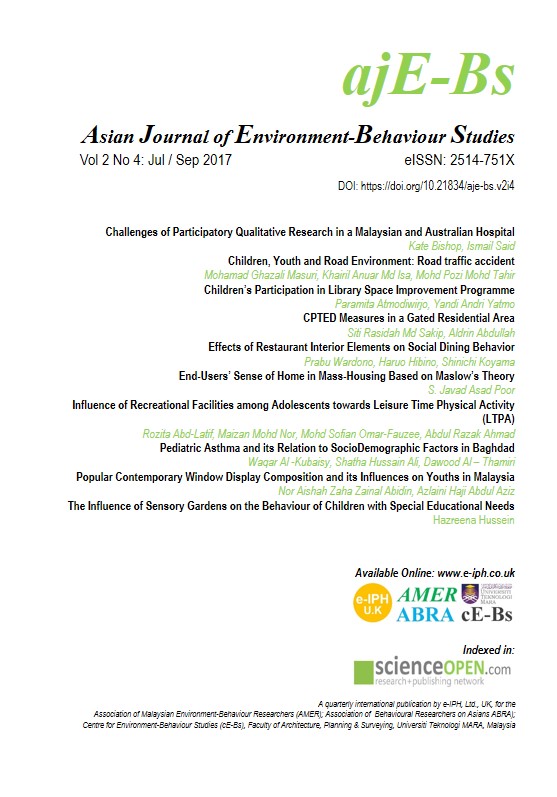
Pediatric Asthma and its Relation to SocioDemographic Factors in Baghdad
DOI:
https://doi.org/10.21834/aje-bs.v2i4.212Keywords:
Asthma, Environmen, Social, ChildrenAbstract
Asthma is one of the most common chronic diseases of children, causing a huge burden on family and society It‟s prevalence has risen sharply over the past 30 years in many parts of the world with large geographical variations. However, in Iraq there is no national database which could be obtained. Due to the increasing number of cases and the burden of this health problem we investigated the sociodemographic and other risk factors related to asthma among primary school children. Modified ISAAC questionnaires were completed by the parents of 2262 children randomly chosen. We found males having higher rat of asthma Bing male be more at risk of developing asthma steadily increasing (27.4%), (28.3%)and (39.5%) with increased (CR) crowding rate (<3, 5 - 5,and >5) respectively. only CR of >5 acts as a significant risk factor for asthma. Urbanization acts as significant risk for developing asthma.
References
Al – Dawood KM. (2001). Epidemiology of bronchial asthma among school boys in Al – Khobar city, Saudi Arabia. Saudi Medical Journal, 22(1): 61 – 66. DOI: https://doi.org/10.5144/0256-4947.2002.29
Alba MF, & Alsina DJ. (1999). Clinical epidemiological study of lower respiratory tract illness with wheezing in children 2 years of age and it‟s risk factors. An Esp Pediatr. 50 (4): 374 – 83.
Anonymoud -1- (n.d.)Asthma in Children and Adolescent http://adam.about.com/reports/000005_3.htm
Anonymoud -2- (n.d.) Asthma in Children: Symptoms and Risk Factors http://www.webmd.com/asthma/children.
Braun-Fahrlander C. (2001). The role of the farm environment and animal contact for the development of asthma and allergies. Clin Exp Allergy, 31: 1799–1803. DOI: https://doi.org/10.1046/j.1365-2222.2001.01269.x
Burke W, Fesinmeyer M, Reed K, Hampson L,& Carlsten C. (2003). Family history as a predictor of asthma risk. Am J Prev Med.; 24 (2): 160 – 9. DOI: https://doi.org/10.1016/S0749-3797(02)00589-5
Busse WW. (2000). Mechanisms and advances in allergic diseases. J Allergy Clin Immunol. 105 (6 pt 2): S 593 – 8. DOI: https://doi.org/10.1067/mai.2000.106149
Carrer P, Maroni M, Alcini D& Cavallo D. (2001). Allergens in indoor air: environmental assessment and health effects. Sci Total Environ. 10; 270 (1 3): 33 – 42. DOI: https://doi.org/10.1016/S0048-9697(00)00791-9
Chatkin MN Menezes AM, Victora CG, & Barros FC. (2003). High prevalence of asthma in preschool children in southern Brazil: a population – based study. Pediatr Pulmonol. 35 (4): 296 – 301 DOI: https://doi.org/10.1002/ppul.10229
Chen J & Millar WJ. (1999). Birth outcome, the social environment and child health. Health Resp. 10 (4): 57 – 67 (Eng).
Douwes J &Pearce N. (2002). Asthma and the Westernization Package. International Journal of Epidemiology 31(6): 1098 – 1102. DOI: https://doi.org/10.1093/ije/31.6.1098
Ece A, Ceylan A, Saraclar Y, Saka G, Gürkan F, &Haspolat K. (2001). Prevalence of asthma and other allergic disorders among schoolchildren in Diyarbakir, Turkey. The Turkish Journal of Pediatrics . 43: 286 – 292.
Guilbert T& Krawiec M. (2003). Natural history of asthma. Pediatr Clin North Am. 50 (3): 523 – 38. DOI: https://doi.org/10.1016/S0031-3955(03)00044-0
Guilbert T& Krawiec. (1999).Incidence of bronchial asthma in a children hospital, Jeddah. Saudi Medical Journal; 20 (7): 526 – 530.
Jan Vermeulen (n.d) Risk Factors for Childhood Asthma http://www.asthma.co.za/default.htm
Johnson C.C., Ownby D.R., Zoratti E.M., Alford S.H., Williams L.K., & Joseph C.L., (2002). Environmental epidemiology of pediatric asthma and allergy. Epidemiol Rev 24: 154–175. DOI: https://doi.org/10.1093/epirev/mxf013
Karunasekera K.A., Jayasinghe J.A., & Alwis L.W., (2001) Risk factors of childhood asthma: a Sirilanka study. J Tropical Pediatr. 47 (3):142-5. DOI: https://doi.org/10.1093/tropej/47.3.142
Lau Y.L, Kalberg J., & Yeung C.Y., (1995) Prevalence of and factors associated with childhood asthma in Hong Kong. Acta Pediatr. 84(7): 820 – 2. DOI: https://doi.org/10.1111/j.1651-2227.1995.tb13767.x
Martinez F.D, Cline M., & Burrows B., (1992) Increased incidence of asthma in children of smoking mothers. Pediatrics; 89(1): 21 – 26. DOI: https://doi.org/10.1542/peds.89.1.21
Mochizuki H., & Morikawa A. (2001). Childhood asthma. Nippon Rinsho. 59(10): 1919 – 24 . [abstract]
Muhammad Towhid Salam, Yu-Fen Li, Bryan Langholz, & Frank Davis Gilliland (n.d) :Early-Life Environmental Risk Factors for Asthma: Findings from the Children‟s Health Study Environmental Health Perspectives. http://ehp03.niehs.nih.gov/article/fetchArticle.action?articleURI=info:doi/10.1289/ehp.6662
Partridge M.R. ,& Alwan Ala‟din. (1997). Prevention of asthma and approaches for enhanced care in the Eastern Mediterranean Region. Eastern Mediterranean Health Journal, 3(1): 133 – 143 DOI: https://doi.org/10.26719/1997.3.1.133
Riedler J., Braun-Fahrlander C., Eder W., Schreuer M., Waser M., Maisch S, et al. (2001). Exposure to farming in early life and development of asthma and allergy: a cross-sectional survey. Lancet 358: 1129–1133. 17. DOI: https://doi.org/10.1016/S0140-6736(01)06252-3
Rona R.J., Duran T.E., & Chinn S. (1997). Family size, atopic disorders in parents, asthma in children and ethnicity. J Allergy Cli Immunol. 99(4): 454-60. DOI: https://doi.org/10.1016/S0091-6749(97)70070-8
Ronmark E., Jonsson E., Platts M.T., & Lundback B. (1999). Different pattern of risk factors for atopic and nonatopic asthma among childrenrepot from the obstructive lung disease in Northern Swedeen. Allergy. 54 (9): 926 – 35. DOI: https://doi.org/10.1034/j.1398-9995.1999.00044.x
Rorstad A., & Bhatt Mehta.V. (2000). Outpatient management of asthma in children .Pharmacy Times.:55– 66.
Strachan D.P., Anderson H.R., Limb E.S., O‟Neill A., & Wells N. (1994). A national survey of asthma prevalence, severity and treatment in Great Britain,. Archives of disease in childhood 70: 174 – 178. DOI: https://doi.org/10.1136/adc.70.3.174
Von Mutius E. (2000). The burden of childhood asthma. Arch. Dis Chid. 82 Suppl 1:2112 – 5. [abstract] DOI: https://doi.org/10.1136/adc.82.suppl_2.ii2
Von Ehrenstein O.S, Von Mutius E., Illi S., Baumann L., Bohm O., & von Kries R. (2000). Reduced risk of hay fever and asthma among children of farmers. Clin Exp Allergy 30: 187–193 DOI: https://doi.org/10.1046/j.1365-2222.2000.00801.x
Von M.E. (2000). The environmental predictors of allergic disease. J Allergy Clin Immunol. 105 (1 pt 1): 9 – 19. DOI: https://doi.org/10.1016/S0091-6749(00)90171-4
Wickens K., Crane L., Kemp T., Lewis S., D‟Sonza W., Sawyer G., et al. (2002). A case – control study of risk factors for asthma in NewZealand children. Aust N Z J Public Health . 2001; 25 (1): 44 – 9. DOI: https://doi.org/10.1111/j.1467-842X.2001.tb00549.x
Wood R.A., Pediatric asthma. JAMMA Middle East.;12(12): 40 – 42.
Yazicioglu M., Saltik A., Ones U., Sam A., Ekerbicer H.C., & Kircuval D. (1998). Home environment and asthma in school children from the Edrine region in Turkey. Allergol Immunopathol Madr.; 26(1): 5 – 8.
Yuan W., Basso O., Sorensen H.T., & Oslen J. (2002) Fetal growth and hospitalization with asthma during early childhood: a follow- up study in Denmark. International Journal of Epidemiology 31(6): 1240 – 1245. DOI: https://doi.org/10.1093/ije/31.6.1240
Downloads
Published
How to Cite
Issue
Section
License
Copyright (c) 2017 Waqar Al -Kubaisy, Shatha Hussain Ali, Dawood Al-Thamiri

This work is licensed under a Creative Commons Attribution-NonCommercial-NoDerivatives 4.0 International License.